
Make your mortgage website a lead-generating powerhouse with SEO strategies that work in 2025.
Your mortgage website is no longer just a digital brochure—it’s your 24/7 lead generator, brand ambassador, and trust-builder. In today’s competitive market, homebuyers and refinance clients expect more than static pages; they want interactive tools, helpful content, and seamless navigation.
But here’s the problem: even the most beautifully designed website can fail if it lacks SEO-friendly content architecture. Without it, search engines struggle to understand your site, users get lost, and you miss out on valuable organic traffic.
An SEO-friendly structure ensures your website is organized logically, with clear silos for services, locations, and resources. It helps Google crawl your pages efficiently while guiding visitors step-by-step toward conversion.
This approach doesn’t just improve rankings—it creates a better user experience that builds trust and keeps people engaged. Think of it as laying the foundation for your online success.
Want your site to attract, engage, and convert like a pro? It starts with smart content architecture.
Key Takeaways
- Understand what SEO-friendly content architecture means for mortgage websites
- Learn why structure impacts rankings and lead generation
- Get step-by-step tips to create optimized site layouts
- Explore internal linking strategies to increase dwell time and authority
- Integrate Digital Closing Trends & Tools for future-ready websites
- See real examples and stats proving SEO-driven content works
Why Content Architecture Matters for Mortgage Websites
Did you know 75% of users never scroll past the first page of Google? If your mortgage website isn’t ranking, your competitors are getting the leads.
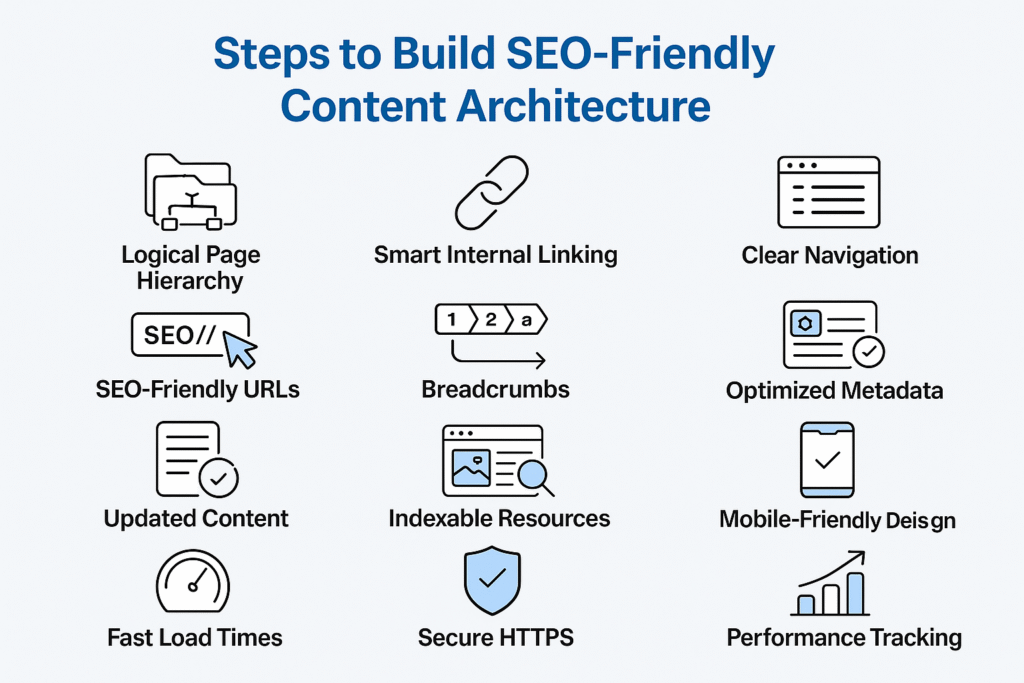
Content architecture refers to how your pages, posts, and resources are organized so search engines can easily crawl, understand, and rank them. For mortgage sites, this includes:
📂 Logical page hierarchy (Home → Services → Mortgage Options → FHA Loans)
🔗 Smart internal linking
📄 SEO-optimized URLs and breadcrumbs
📱 Mobile-first design for seamless user experience
A poor structure leads to high bounce rates and low lead conversions, while a well-planned architecture keeps visitors engaged and search engines happy.
Elements of SEO-Friendly Content Architecture
1️⃣ Clean and Logical URL Structure
Your URLs should:
Be short and descriptive (e.g.,
/fha-loansinstead of/page?id=12345)Include keywords naturally
Reflect site hierarchy
Example:
✅ Good: yoursite.com/loan-options/fha-loans
❌ Bad: yoursite.com/services-page1-xyz
2️⃣ Pillar Pages and Topic Clusters
Use the pillar-cluster model to organize your mortgage content:
- Pillar Page: This is your in-depth, ultimate guide on a broad topic. For a mortgage site, a perfect example would be “Mortgage Options Explained.” This page isn’t just a quick summary; it’s a comprehensive resource covering various loan types, qualification rules, the application process, and more. It acts as the central hub for everything related to that topic on your site.
- Clusters:These are specific, detailed articles—usually blog posts—that dive deeper into a sub-topic and link back to your main pillar page. So, if your pillar is “Mortgage Options Explained,” your clusters might include articles like:
“FHA vs. VA Loans vs USDA” (a detailed comparison)”FHA loan for First-Time Homebuyer” (clearing up common misunderstandings)
3️⃣ Internal Linking Strategy
Search engines crawl your site through links. Create a web of internal links:
- From homepage to services
- Between related blogs
- From loan product pages to contact forms
Example:
On your FHA Loans page, link to:
👉 “First-Time Homebuyer Checklist”
👉 “Pre-Approval Process Explained”
Ready to Attract More Leads?
Launch your high-performing mortgage website fast no contracts, no hassle.

Steps to Build SEO-Friendly Content Architecture
Building an SEO-friendly website for mortgages means carefully planning your content. Here’s a concise guide:
Step 1: Map Your User Journey
- What are they searching for at each stage of the mortgage process? Are they just starting to explore options (e.g., “what is an FHA loan?”) or are they ready to apply (e.g., “mortgage rates today”)?
- Where do they drop off or get confused on your current site (if applicable)? Identifying friction points can reveal content gaps or navigational issues.
- What content can effectively guide them from initial interest to conversion (e.g., submitting an application or contacting a loan officer)?
Step 2: Create a Sitemap
Develop a comprehensive visual sitemap that clearly outlines the structure of your website’s content. This sitemap serves as a blueprint for your SEO-friendly architecture, ensuring logical flow and comprehensive coverage. Key sections to include are:
- Homepage: The central entry point to your site.
- Loan Programs: Dedicated pages for each specific loan type you offer (e.g., FHA Loans, VA Loans, Conventional Loans, USDA Loans, Jumbo Loans, Refinance Options). Each of these should ideally be its own pillar page.
- Resources: A hub for valuable, evergreen content (e.g., Blog, Frequently Asked Questions (FAQs), detailed Guides/E-books, Glossary of Mortgage Terms). This is where your topic clusters will often reside.
- About Us/Company Information: Pages detailing your company’s mission, team, and contact details, building trust and credibility.
- Contact and Application Pages: Clear, easy-to-find pages for users to get in touch, schedule appointments, or begin the application process.
Step 3: Optimize Each Page
- Use H1, H2, H3 headings correctly for structure and keywords.
- Craft compelling meta titles and descriptions that include primary keywords to attract clicks from search results.
- Embed rich media like videos, interactive calculators, and downloadable PDFs to boost engagement and signal value to Google.

Ready to Attract More Leads?
Launch your high-performing mortgage website fast no contracts, no hassle.

Frequently Asked Questions
What is SEO-friendly content architecture for mortgage websites?
It’s the way your website’s pages and content are structured to help Google understand your site and rank it higher. A clean architecture makes it easier for borrowers to find what they need, improving user experience and SEO at the same time.
Why does content architecture matter for my mortgage website?
Because it impacts how search engines crawl your site and how easily visitors can navigate it. A well-structured site means lower bounce rates, higher engagement, and more qualified leads.
Why is it important for mortgage brokers?
A clear structure helps borrowers find information faster and improves your SEO visibility.
Is mobile-friendly design really necessary?
Absolutely. Over 60% of visitors use mobile devices, and Google ranks mobile-first.
How many pages should my mortgage website have?
At least 5 core pages: Homepage, Loan Programs, About Us, Blog, and Contact.
How can internal linking improve my site’s SEO?
Internal links guide both users and search engines to related content. This increases dwell time, distributes page authority, and helps Google rank more of your pages.
Can I integrate a CRM with my mortgage website?
Absolutely. Platforms like GetMortgageWebsite.com come with a built-in CRM so you can manage leads, schedule tasks, and automate follow-ups—all without needing third-party tools.
Conclusion
A well-planned SEO-friendly content architecture does more than impress Google. It creates a seamless user journey that keeps visitors engaged and builds trust in your brand. For mortgage businesses, this means higher rankings, more leads, and stronger local visibility. By organizing your site for both users and search engines, you set the foundation for long-term success. Start building your future-ready mortgage website today to dominate local search and convert visitors into clients.
Ready to Attract More Leads?
Launch your high-performing mortgage website fast no contracts, no hassle.