

Your website is your digital storefront. For mortgage professionals, it might be the very first impression a potential homebuyer has of your business and in such a trust-sensitive industry, that impression matters enormously. But here’s the thing: you don’t need to spend thousands on a custom build to look polished and professional. The right mortgage website template can get you there faster, cheaper, and with a lot less stress.
The challenge is that not all templates are created equal. Some look great in a preview but fall apart under real-world conditions. Others are technically sound but feel cold and uninspiring. Choosing wisely means knowing what to look for before you commit.
Key Takeaways
- A great mortgage website template balances good design with practical functionality like calculators and lead capture forms
- Mobile responsiveness and fast load speed are non-negotiable for both user experience and SEO rankings
- Trust signals like testimonials, licensing info, and clear CTAs directly impact conversion rates
- Customizability matters your template should reflect your brand, not a generic placeholder
- Compliance-friendly layouts help mortgage professionals avoid regulatory headaches
- Integration with CRM tools and mortgage calculators can turn your site into a lead-generation engine
Why Your Website Template Choice is More Important Than You Think
Most homebuyers start their mortgage search online. They’re comparing lenders, researching rates, and reading reviews long before they ever pick up the phone. If your site looks outdated, loads slowly, or doesn’t answer their basic questions, they’ll click away without a second thought.
A template sets the foundation for everything — layout, speed, structure, and tone. It’s not just decoration. It determines how easy it is for visitors to find your contact form, understand your loan products, and ultimately trust you with one of the biggest financial decisions of their lives.
That’s why choosing the best mortgage website template deserves careful thought, not a quick pick from a free theme library.
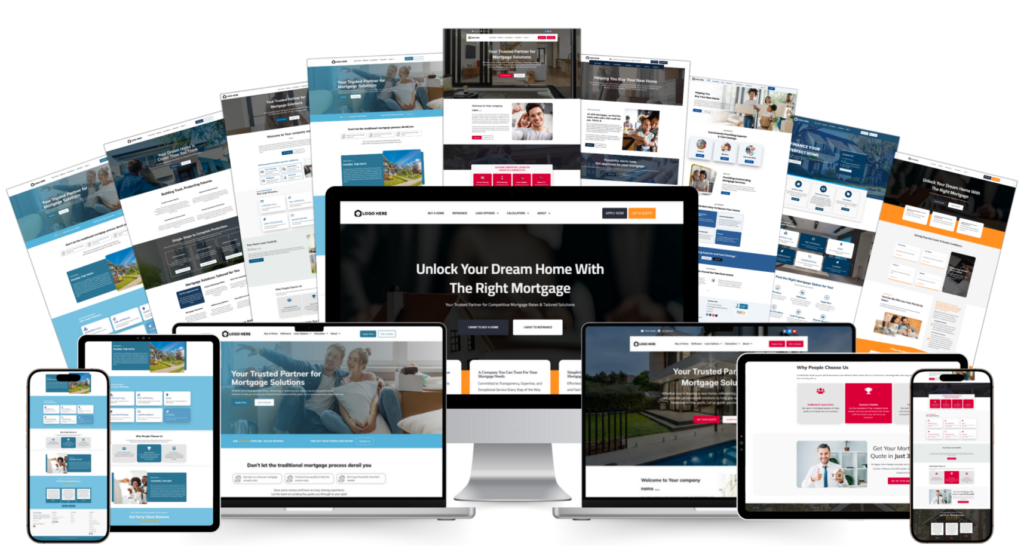
What Makes a Mortgage Website Template Stand Out
Design That Communicates Trust
The mortgage industry runs on trust. Your website design should communicate stability, professionalism, and approachability — all at once. Look for templates with clean, uncluttered layouts, high-contrast text for readability, and a color palette that feels grounded rather than flashy. Think navy blues, clean whites, and warm neutrals rather than neon and overloaded graphics.
Good typography matters too. Easy-to-read headings and body text reduce cognitive load for visitors who are already stressed about the homebuying process.
Mobile Responsiveness Is Non-Negotiable
Over 60% of web traffic now comes from mobile devices. If your mortgage website doesn’t look and function perfectly on a smartphone, you’re losing leads. Always test a template on mobile before committing — look at how forms render, whether CTAs are easy to tap, and how fast pages load on cellular data.
Built-In or Easy-to-Add Calculators
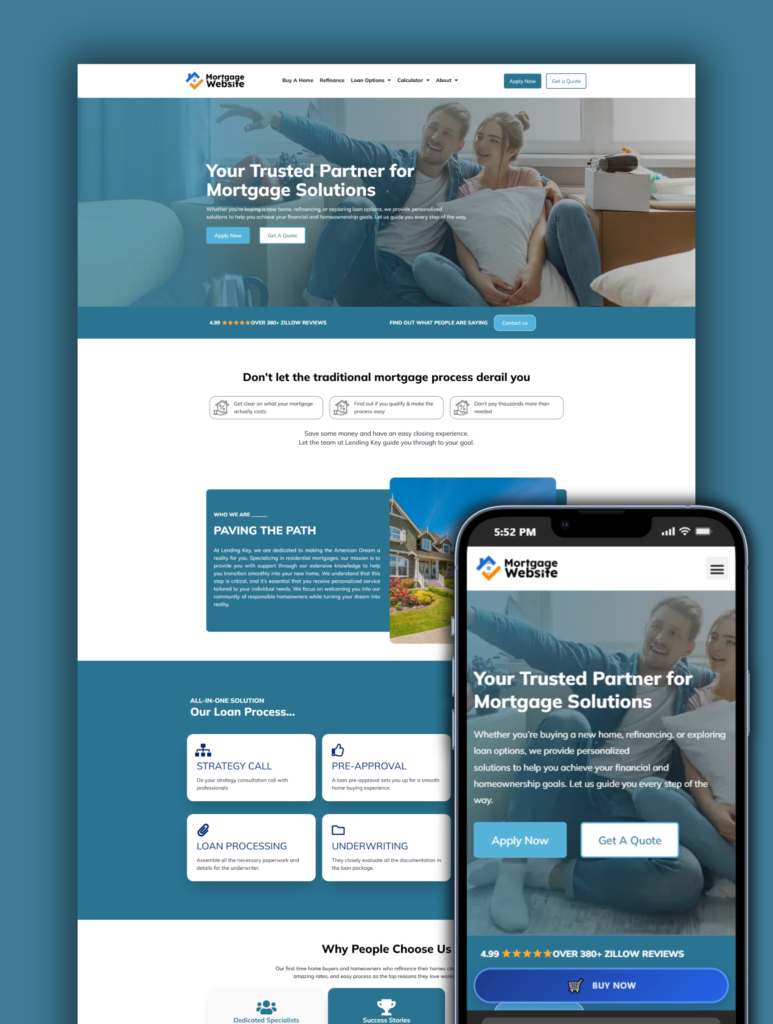
One of the most powerful tools on any mortgage site is an interactive calculator. Monthly payment estimators, affordability tools, and refinance calculators keep visitors engaged and pre-qualify them as serious prospects. A strong template either includes these natively or has clear integration points where you can plug them in without a developer.
Want to simplify your mortgage journey?
Explore tools, calculators, and homebuyer content at GetMortgageWebsite.com.

The Best Mortgage Website Template Features You Should Always Check
When evaluating your options, run every template through this checklist.
Lead Capture and Contact Forms
Every page on your site should have a path to conversion. That means strategically placed contact forms, “Get Pre-Qualified” CTAs, and click-to-call buttons. Look for templates that make form placement flexible and easy to customize.
SEO-Friendly Structure
A beautiful site that no one finds is just a pretty waste of money. Templates built with clean HTML, proper heading hierarchy (H1, H2, H3), and fast load times will give you a meaningful SEO advantage. Check whether the template supports metadata editing, schema markup, and fast page speeds out of the box.
Trust Signals and Social Proof
Testimonials sections, star-rating displays, licensing badges, and lender logos all serve one purpose: building confidence. A best-in-class mortgage website template will have dedicated sections for these elements rather than making you force them awkwardly into a generic layout.
Clear Navigation
Visitors should be able to find your loan products, rates, team page, and contact info within two clicks. Confusing menus and buried pages hurt both user experience and SEO. Prioritize templates with intuitive, flat navigation structures.
How to Evaluate Templates Before You Buy
Start With Your Audience in Mind
A template for a high-volume retail lender looks different from one built for a boutique broker who serves first-time homebuyers. Who are your clients? What do they need to see to feel comfortable moving forward? Let that answer guide your selection rather than just picking whatever looks impressive in a demo screenshot.
Test Performance, Not Just Looks
Run any template you’re considering through Google PageSpeed Insights or GTmetrix. Slow load times aren’t just annoying — they tank your Google rankings and increase bounce rates. A template clocking in under three seconds on mobile is a strong signal of quality in the underlying code.
Check Customization Depth
You want a template that’s easy to make your own. Can you change fonts, colors, and layouts without touching the code? Does it support your logo and brand imagery naturally? A great template gives you a strong starting point without boxing you into someone else’s brand identity.
Verify CRM and Integration Compatibility
If you’re using tools like Salesforce, HubSpot, or a mortgage-specific CRM, confirm your template plays nicely with those systems. Email marketing integrations, chat widget support, and calendar booking tools can transform a static brochure site into an active sales tool.
Common Mistakes to Avoid When Choosing a Mortgage Website Template
Even experienced marketers slip up here. Watch out for these pitfalls:
- Choosing aesthetics over functionality a gorgeous template that lacks lead capture tools won’t help your bottom line
- Ignoring accessibility: templates that don’t meet basic WCAG standards can alienate users and create legal exposure
- Skipping compliance review: mortgage marketing is regulated; make sure your template supports required disclosures without layout awkwardness
- Locking yourself into a rigid structure: templates with no flexibility become liabilities as your business grows and your offerings change
- Overlooking page speed heavy animation and oversized images might look impressive but slow down your site dramatically
A Platform Built Specifically for Mortgage Professionals — GetMortgageWebsite.com
If you’re looking for a solution that checks every box in this guide, GetMortgageWebsite.com is worth a serious look. Built exclusively for mortgage brokers, loan officers, and independent mortgage bankers, it delivers a full website — not just a starter template — with mobile-first designs that score 90+ on Google’s performance standards.
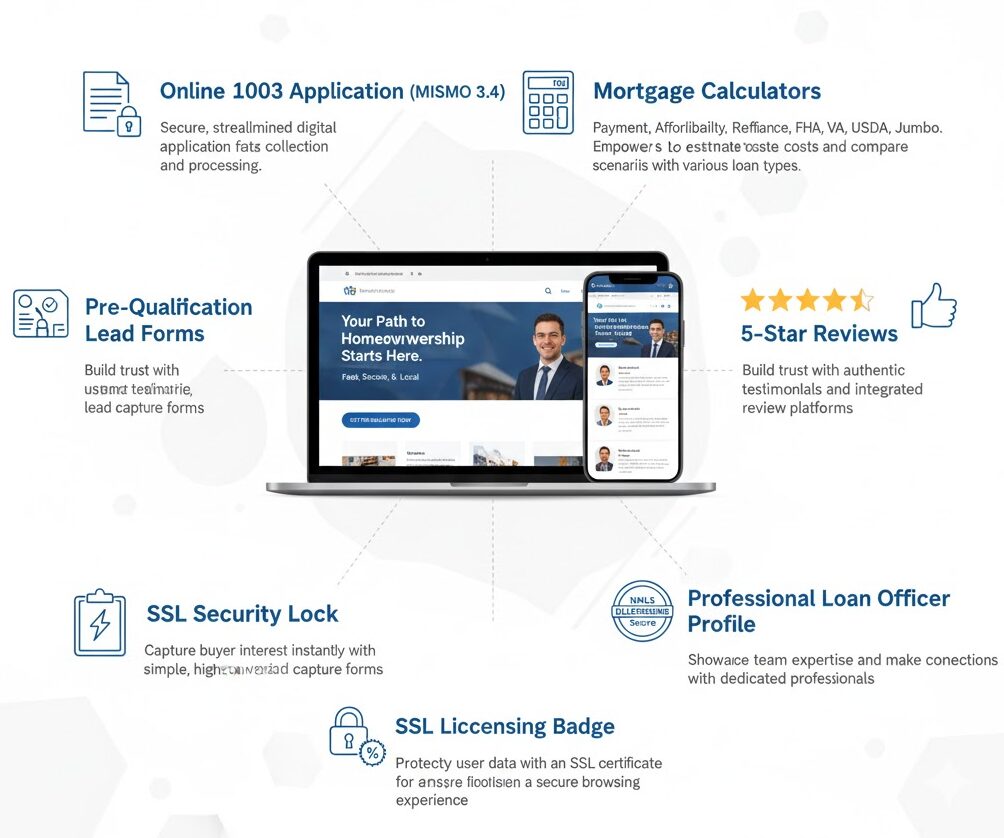
Every plan includes 7 built-in mortgage calculators, 20+ preloaded loan program pages, customizable lead capture forms, a 1003 application integration, an all-in-one review feed from Google, Zillow, Facebook, and more, plus secure hosting, daily backups, and SSL — no extra fees or plugins required. There’s also an integrated CRM for managing clients, automating follow-ups, and tracking your pipeline, all in one place.
Onboarding is refreshingly simple. Provide your logo, bio, and domain — the team builds and launches your site within three to four business days. No contracts, no developers needed, just a flexible monthly plan that grows with your business.
Visit GetMortgageWebsite.com to preview live demos and explore pricing.

Launch Your Mortgage Website Fast
Showcase reviews, capture leads, and grow your business all in one place.

Frequently Asked Questions
What is a mortgage website template?
A mortgage website template is a pre-designed web layout built specifically for mortgage brokers, lenders, or loan officers. It provides the structure, visual design, and often some baseline functionality (like calculator widgets or contact forms) so you can launch a professional website without building from scratch.
How much does a mortgage website template typically cost?
Prices vary widely. Free options exist but often come with limited customization and no support. Premium templates typically range from $50 to $300 as a one-time purchase, while subscription-based website builders designed for mortgage professionals can run $50 to $200 per month, often with hosting and support included.
Do I need a developer to use a mortgage website template?
Most modern templates are designed for non-technical users and come with drag-and-drop editors. That said, deeper customizations like custom integrations with your CRM or loan origination system may require developer help. Choose a template based on your own technical comfort level and budget.
Can a mortgage website template help with SEO?
Yes, significantly. Templates with clean code, fast load times, and proper heading structures give you a much better starting point than a poorly built custom site. That said, the template alone won’t rank your site you still need quality content, local SEO optimization, and backlinks.
What's the difference between a mortgage website template and a mortgage website builder?
A template is a static design file or theme you apply to a platform (like WordPress). A website builder is an all-in-one platform that includes hosting, editing tools, and templates together. Builders like Squarespace or purpose-built mortgage platforms like BeSmartee are more hands-off; WordPress with a mortgage theme gives you more control but requires more setup.
Conclusion
Choosing the right mortgage website template isn’t just about finding something that looks nice — it’s about finding a platform that works hard for your business every single day. From trust-building design and mobile performance to calculators, SEO structure, and compliance-friendly layouts, the best mortgage website template is one that aligns with how your clients think and what they need to feel confident moving forward.
Take your time, test your options thoroughly, and don’t settle for “good enough.” In a competitive lending market, your website is often the difference between a lead that converts and one that bounces to a competitor. Get the foundation right, and everything else becomes easier.
Skip the Tech Headaches
We handle the website. You focus on loans.
🔒 Secure, backed up, and mortgage calculators