

If your mortgage website isn’t bringing in leads while you sleep, something is missing.
A lot of loan officers and mortgage brokers invest in a website, wait a few months, and then wonder why the phone isn’t ringing. The truth is, not every website is built the same way. A generic template slapped together with stock photos and a contact form isn’t going to cut it in today’s competitive mortgage market.
The right mortgage website builder changes all of that. It gives you a platform that works like a 24/7 sales machine, attracting the right visitors, building trust instantly, and converting browsers into borrowers.
So what separates a high-converting mortgage website from one that just sits there? It comes down to three core features. Get these right, and everything else falls into place.
Key Takeaways
- A high-converting mortgage website needs more than good design it needs smart lead capture built in from the start
- Trust signals like reviews, credentials, and clear messaging directly impact whether a visitor stays or leaves
- Mobile-first design is no longer optional most of your borrowers are searching on their phones
- The best mortgage website builder combines all three of these features under one roof, saving you time and money
- Speed and performance matter a slow website loses leads before you even get a chance to introduce yourself
Why Most Mortgage Websites Fail to Convert
Here’s a hard truth: most mortgage websites are built for the loan officer, not the borrower.
They’re loaded with industry jargon, buried contact forms, and zero direction for someone who just wants to know if they qualify for a loan. The visitor gets confused, feels no connection, and clicks away probably to your competitor.
High conversion isn’t about flashy design. It’s about removing friction and giving your visitor exactly what they need to take the next step. That starts with three non-negotiable features.
Feature 1: Smart Lead Capture Forms That Actually Get Filled Out
Your lead capture system is the engine behind your website’s performance. Without it, you’re just publishing content into the void.
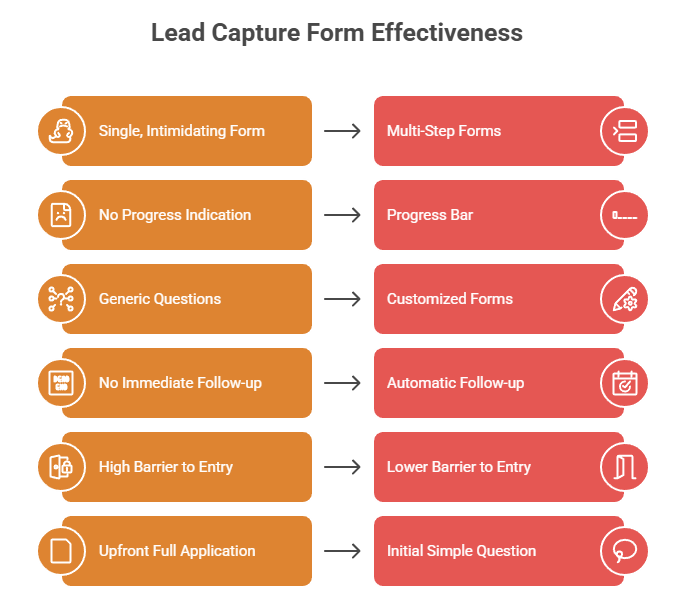
But here’s where most mortgage websites get it wrong: they use a single, intimidating contact form with ten fields and call it a day. Nobody fills those out. Borrowers are busy, and they’re cautious about sharing personal information with someone they’ve never met.
A high-converting mortgage website builder solves this with smart, multi-step lead capture forms that guide visitors through the process naturally.
What makes a lead form convert
- Keep the first step simple, ask just one or two questions (like loan purpose or estimated credit range)
- Use a progress bar so visitors know how many steps are left
- Make it mobile-friendly with large tap targets and auto-fill support
- Customize the form based on loan type a purchase buyer needs different questions than someone refinancing
- Follow up automatically with a personalized thank-you page or booking link
The goal is to lower the barrier to entry. Once someone starts a form, they’re far more likely to finish it. That first small commitment is the most important one.
Real-world example: Instead of asking for a full application upfront, start with “What are you looking to do?” and give them three buttons Buy a Home, Refinance, or Learn More. That single change can dramatically increase form completions.
Want to simplify your mortgage journey?
Explore tools, calculators, and homebuyer content at GetMortgageWebsite.com.

Feature 2: Built-In Trust Signals That Do the Selling for You
Think about the last time you hired someone for a big decision. Did you Google them first? Check their reviews? Look for proof they’d done it before?
Your borrowers do the same thing. And they decide within seconds whether your website feels trustworthy or not.
This is why a strong mortgage website builder must include built-in tools for showcasing trust signals — not as an afterthought, but as a core part of the design.
Trust signals that move the needle
- Star reviews pulled from Google, Zillow, Facebook, and BBB: don’t make visitors go searching for proof; bring it directly to them
- A professional bio with a real photo: people work with people, not logos
- Loan program content: showing that you understand FHA, VA, USDA, Jumbo, and conventional loans tells borrowers you know your stuff
- Licensing and credentials: your NMLS number, state licenses, and certifications should be easy to find
- Video introductions: a short 60-second video on your homepage can build more trust than three paragraphs of text
When trust is baked into the design, you don’t have to convince visitors to reach out. They already feel confident before they ever hit “submit.”
A first-time homebuyer landing on your site is nervous. They’re about to make the biggest financial decision of their life. Your website’s job is to make them feel like they’ve already found the right person.
Feature 3: Mobile-First Design With Lightning-Fast Performance
Here’s a stat worth bookmarking: more than 60% of web traffic now comes from mobile devices. In mortgages, that number is only growing as younger buyers enter the market.
If your website looks clunky on a phone, loads slowly, or has buttons too small to tap, you’re losing leads, and you may not even know it.
Google knows it, though. Page experience and Core Web Vitals are ranking factors, which means a slow or poorly designed mobile site hurts your visibility in search results. It’s a double hit: fewer visitors find you, and the ones who do leave before converting.
What mobile-first mortgage design looks like in practice
- Fonts and buttons are sized for thumbs, not mouse clicks
- Pages load in under three seconds on a 4G connection
- Navigation collapses into a clean mobile menu
- Lead forms are easy to complete on a small screen
- Click-to-call buttons appear prominently so borrowers can reach you instantly
- Google PageSpeed scores consistently hit 90 or above
The best mortgage website builder doesn’t just make your site “work” on mobile, it builds from mobile up, treating the phone experience as the priority and scaling up to desktop from there.
Speed matters as much as design. A one-second delay in page load time can reduce conversions by up to 7%, for a mortgage website fielding dozens of visitors a day, that adds up fast.
How These Three Features Work Together
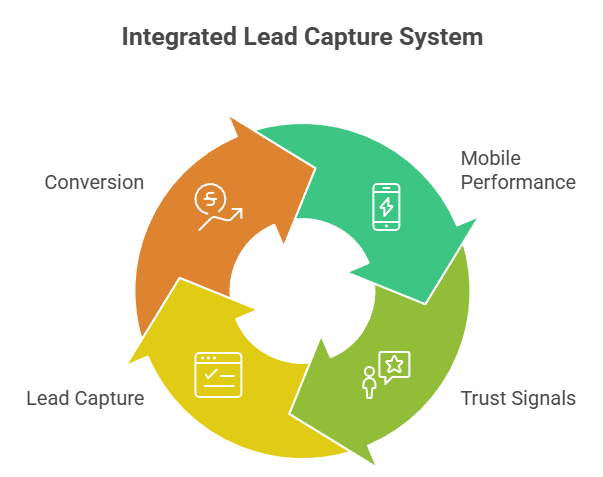
Lead capture, trust signals, and mobile performance aren’t three separate boxes to check. They work together as a system.
A borrower finds your site through Google on their phone (mobile performance). They land on a clean, professional page with five-star reviews and a friendly photo (trust signals). They see a simple two-step form asking about their homebuying timeline and click “Get Started” (lead capture).
That’s a conversion. And it happens because every part of the experience was designed to reduce doubt and make the next step obvious.
When even one piece is missing, the chain breaks. A great form on a slow website still loses leads. A fast website with no reviews still leaves visitors unsure. All three features need to be present and working together.
Launch Your Mortgage Website Fast
Showcase reviews, capture leads, and grow your business all in one place.

Frequently Asked Questions
Do I really need a mortgage-specific website builder, or can I use a general platform?
Yes. General platforms like Wix or Squarespace lack loan program content, compliant forms, and mortgage calculators. A mortgage-specific builder gets you launched faster with tools built for how borrowers actually shop.
How long does it take to launch a high-converting mortgage website?
With the right platform, as little as three to five business days — especially when the provider handles the build, content, and setup for you.
What should I include on my mortgage website homepage?
Answer three things instantly: who you are, what you offer, and why borrowers should trust you. A headline, bio, loan programs, lead form, and review feed cover the essentials.
Is SEO included in most mortgage website builders?
Not always. Look for fast load times, clean URLs, mobile optimization, and a built-in blog. Pre-written loan program pages structured for search are a big bonus.
Can I make edits to my website without calling support?
You should be able to handle basic updates — bio, photos, blog posts — on your own. A responsive support team for bigger changes is a valuable safety net.
Conclusion
Your mortgage website should be your hardest-working team member — available 24/7, never missing a lead, and always making a great first impression.
That only happens when you build on the right foundation. Smart lead capture keeps prospects in the funnel. Strong trust signals turn curiosity into confidence. Mobile-first performance makes sure your site shows up and loads fast for every borrower, on every device.
The right mortgage website builder brings all three of these together without requiring you to stitch together a dozen different tools or manage a developer every time you need a change.
If your current site isn’t checking all three boxes, it’s worth asking what leads you might already be leaving on the table — and what it would mean for your business if you weren’t.
Skip the Tech Headaches
We handle the website. You focus on loans.
🔒 Secure, backed up, and mortgage calculators